
The Developer Track was a series of 20 min technical talks on the second day of the conference. As Marshall McLuhan said “The Medium is the Message”. The message here is “We’re not going deep”. OK – at least if a presentation is not engaging, I’ll only need to sit through 20 mins of it. But for the great presentations – and there were several – it wasn’t enough time IMHO. And when there were technical difficulties (a couple of times), then you really felt how short the time was.
Here’s some of the stuff I saw / heard at the Dublin Web Summit, Developer Track.

On Recruitment – Matt Mickiewicz, Co-Founder of 99designs, SitePoint and Flippa
- Google has 900 recruiters!
- Go see The Recruiter Honeypot post by Elaine Wherry
- $1MM cost per engineer for acqui-hires
- Kayak CEO: 7-day countdown timer from first contact to hire
- Google reduced # of interviews from 10 down to 3, because subsequent interviews only provided 1% more useful information

On Culture- Eamon Leonard, VP of Engineering at Engine Yard
- Culture isn’t the quirk things in the office (beer fridges, games)
- Healthy culture rests upon trust and communication.
- Cofounders and first-hires have huge impact on culture.
- What about an established company culture? You can influence it.
- VP of Engineering’s Job: Help the team kick-ass! Facilitate the ability for people smarter than you to kick-ass!
- There are teams, projects and locations. The challenge is to facilitate trust and communication.
- You have to spend face-time with people to engender trust. People bond over shared conversations and experiences.

On Solving Browser Problems – Rachel Andrew, Founder of edgeofmyseat.com
Rachel spent most of her time advocating for people to really understand what’s going on behind the tools (jQuery, Polyfills, etc).
- IE8 and below don’t support media queries. response.js will polyfill media queries for IE8. Nobody is using IE8 on mobile anyways.
- IE8 and below don’t support styling HTML5 semantic elements. Maybe you’re ok with the degraded experience on these older browsers. html5.js can polyfill support in older browsers
- Some older browsers don’t support certain CSS3 selectors. selectivizr can polyfill some of them.
- You should know what happens if the JS on your site doesn’t load.

On Using Data – Anna Dahlström, Co-founder of byFlock
Anna gave a quite high-level talk about the nature and use of data. Some takeaways:
- Build-in analyticsin your prototypes and production from Day 1 because these will inform the design process.
- Apparently 57 slaves work for me, Not very positive response when I tweeted that. Very cool UI on this site.

On Twilio – Jon Gottfried, Developer Evangelist at Twilio
A very well-received and entertaining presentation, where Jon live-coded a simple Twilio app that:
- Received calls from the audience (and played a simple prompt)
- Called people in the audience back and put them into a audio conference. A cacophony of rings and echoes ensued.

Why CEOs don’t get it – Peter Cosgrove, Director of Technology, Engineering & Science at CPL
- CEOs are looking for CTOs that are influencers and revenue generators.
- Funny quote “Employees have peaked at the moment you hire them, it’s only downhill from there”.
- Not many other concrete take-aways.

On APIs – Frank Fischer, Head of B2B2X Software & Platform at Deutsche Telekom
Frank admitted that the telecoms weren’t very effective at catering for developers or supporting open ecosystems on their infrastructure. Deutsche Telekom has a project Gestalt that is re-imaging their relationship with developers – and it starts with empathy for developers: their goals, motivations, frustrations.
Be careful of letting your architects build the external API. It might not actually solve the problems that developers or other businesses care about. Or they might be too hard to use. When they design an API the focus on 3 things:
- External Usecases
- Internal Usecases
- The technological factors (security, performance, etc)
APIs need great companions (SDKs, Demos, How-tos, Docs, Tools, Logs, etc). APIs also need evangelists to take this to the developer community.

On Doing It Wrong – Chris Poole, Founder of 4chan
- “Single points of failure probably aren’t as bad as you think”. There is a tradeoff between cost and availability. 4chan runs on 5 servers, each specialized. [ED: I think he can say this because he isn’t charging anyone for access to 4chan]
- “You probably don’t need an API”. They just added a read-only JSON API. But they are getting 50 Million requests per day on their API now. Half of their traffic was scrapers before the API (600 million page requests / day).
- “HTML is a great cache”. They render static HTML, gzip, push to disk. Serve via Nginx. Cloudflare proxies their HTML requests. Their pages aren’t personalized so they can do this.
- “Let other people solve problems not core to your business”. e.g. Mail, CDN, Captcha, DNS
- “There are no silver bullets”. New technology comes with new problems.
- “Buy used stuff”. e.g. Aeron Chairs, servers. 4chan wouldn’t exist without EBay.
- “No SCM for 5+ years”. They only had 1 developer at a time for years. [ED: Dear lord. This is terrible]
- All the content in 4chan is ephemeral. They don’t save more than 24hrs. So nearly everything can fit into memory. There’s no DMCA worries because things are not saved on the site. Unwitting benefit to the nature of the site.
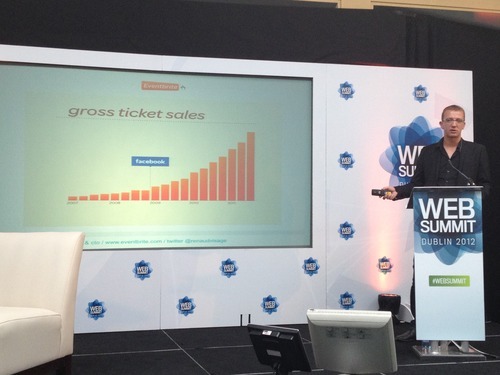
On Scaling to $1B – Renaud Visage, Co-Founder & CTO of Eventbrite
The $1B above is accumulated ticket sales. They’ll do $600M in 2012. They set out to revolutionize ticketing. Renaud covered all the key points when giving good advice on building and scaling a product.
- At the Start: one eng, custom python framework, mysql, apache, one server, no designer.
- Have a network you can lean on for advice (expert friends)
- He gave some of the standard scaling advice: separate db & apps, scale horizontally, backup, build redundancy, create the right indexes, cache DB query results in memcache, master-slave replication.
- Georgetown’s event in 2009 with Obama took down the Eventbrite site.
- Build an API, expose your data.
- Offload non-critical components (email, DNS).
- In 2009 they moved to EC2.
- Use load-balanced slave-pool for DB reads.
- If you want to use continuous deployment, build automated tests. They use Selenium.
- Use git.
- They switched slowly to Django in 2010.
- Introduce feature flags.
- Automate server deployment, server configuration and release process. They use Puppet and Jenkins.
- Replace apache with nginx (in 2010).
- Define coding standards, and enforce formal code review process. They use Review Board.
- Use a queueing system for async processes (RabbitMQ, celery) and to support high load.
- They use big data tools & techniques to build recommendations (they use Hadoop, HBase, Hive).
- Front end automation tests in Javascript
- 180 servers in production today.
- Expect the unexpected
- Welcome the challenges that success brings
- Stay lean, recognize when you need help
- Hire smarter than you. Hire generalists to start up, and then specialists to help you scale.
- Add process as you scale the team.

Thoughts on growth – Josh Elman, Former lead product guy at Facebook and Twitter
Josh shared a bit about the story of Twitter. They were seeking to articulate the persona of someone who uses Twitter. They eventually came to: “Someone who want to know what’s happening in their world”.
At LinkedIn, they focused very intensely on the text of the Invite request. When they defined it as sharing opportunities, acceptance rates took off.
Key focus of the talk: The first time someone interacts with your product is the best time to educate them. Creating a long, educational first experience. He walked through their improvements to the first-time-user experience for Twitter. Very interesting.

On Launching Products – Brenden Mulligan, Founder of Onesheet and other stuff
Things he launched in a 12 month period:
- Photopile – Instagram on the web?
- MorningPics – Sends you your pics each morning
- OneSheet – Splash Pages for Entertainment
- TipList – City Guide
- WebbyGram – How Instagram should look on the web (again?)
Advice on Launching:
- Focus on 3-5 key metrics only!
- Create a simple dashboard. Make a mobile interface to it. Make it your home screen. Send the whole team a daily report email, text based with key #s. Generate simple alerts for important things.
- Target relevant press. Find writers that care about the product, with readers that care more.
- Add sharing into the initial product launch.
- Referral for access does work.
- Gathering Feedback – you don’t need sophisticated ticketing system. Use name@company.com or support@company.com
- Automated emails are okay if they are personal. Plain text. From name@domain.com. Make it super personal. “Hi there! I noticed….”. Start simple, just ask users what they think.

On Products and People – Taso Du Val, CEO of TopTal
I didn’t realize the theme of his topic until the end. Basically he was advocating a method for creating a business and product.
Who makes great products?
- Not great engineers
- Not great visionaries
- Rich People with Experience [Ed: really?] Why Rich People? Time. Less Pressure. Access to People. Most products never become finished.
Model for bootstrapping a business: Start with a low-leverage almost-services business that generates revenue. Then transition into a software product based business. Consumer plays are more difficult than enterprise plays.
On Customers – Des Traynor, Co-founder and COO Of Intercom
A funny an entertaining talk about the customer perspective and when (or when not) to reach out to customers. Not many points to walk away with.
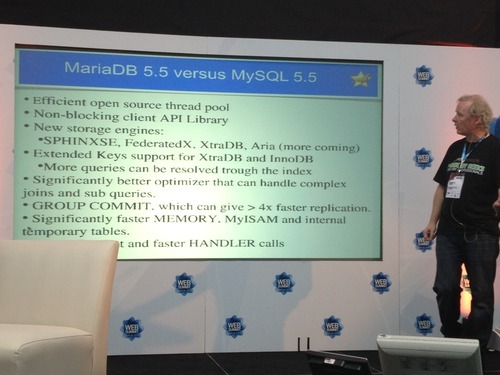
On MariaDB – Monty Widenius, Co-founder of MySQL
His goal was to get the developers to switch to MariaDB. Key points:
- Oracle is slowly closing up MySQL.
- Monty Program Ab is a support company for MariaDB. “Save the People, Save the Product”. Keep the MySQL talent together.
- MariaDB already has a number of improvement over MySQL (performance, replication).
- Great stuff coming (multi-source replication, stats, global transaction ids).
- Trying to get companies to sponsor the work on MariaDB. They have about 15 active developers right now.
- He’s spending his 40 Million euros (from sale to Oracle) on MariaDB

On Beating Google – Ilya Segalovich, Co-founder of Yandex
This was the co-founder and CTO of Yandex – the big search player in Russia. The point of this talk was to spread Yandex awareness out of Russia.
- In Russia, Yandex is beating Google in Search, Email, Maps, E-Commerce Services
- If they’re beating Google in Russia, they must be better!
- It’s not just because of the peculiarities of the Russian language.
- Now they’re competing on platforms. They created a web-browser! (Actually it’s chromium based).
- They’re not playing in Social yet.

Interview / Chat – Mitchell Baker, Chairperson and former CEO of Mozilla
This was one of the better live-interviews I’ve seen. Talked about:
- There’s room for a third mobile platform that is web-baed. Smaller tech stack. Simpler. Firefox OS. Kernel that touches the hardware. Everything else is web based. Apple vs Google vs Mozilla.
- With regard to timing. First Firefox OS phones will ship next year. South American telecomm carriers first.
- They want it so you can ‘view source’ for apps on the phone.
- They want to support app discovery, but not necessarily an app-store clone. Purchases that work across devices.
- She addressed the need for developers to be able to monetize their creations – but no specifics.

Final Thoughts
They didn’t leave time in the schedule for lunch! What? The schedule went from 9:00am until 3:00pm with only a 10 minute break at 11:20. This had three bad consequences:
- The presenters were competing with my hunger for attention. Hmmm… I wonder how effective that is.
- There was no time that could be used to re-align the schedule if presenters went over. As the day progressed the schedule drifted back.
- There was no time to resolve technical issues. In this case the machine that was hosting the presentations was slowing down over the course of the day. Not sure if the presentation software was growing in memory size after some massive decks or what, but I think it would have been helpful to give that poor machine a reboot. Eventually they added a small 5 minute break to do that.
A much better schedule would have involved two 15 min breaks and 30-60 min lunch.
And finally, it’s easy to criticize. But Eamon Leonard and the organizers deserve praise for putting together a day with lots of interesting content. I’m glad I came, and hope to be able to be here again next year.

 Steve Souders, Head Performance Engineering, Google
 Patrick Meenan, Google / WebPageTest


 Brendan Sterne